Friday, June 5, 2015

Hide it under a bushel

He came in to youth group hooded, forty-five minutes late, tailing his older brother. Usually his eyes are so bright, but that night they never came out from the shadow of his hood.

Sometimes I greet one of the boys or ask, "How's it going?", more as a habit of etiquette than because I really think a middle school boy will share his heart with me. But if he was willing, I wouldn't say no to listening. Once Sam took me off guard when I asked the question and forgot to expect an answer.

"I'm tired!" he told me enthusiastically. "I slept terrible last night!" His words were downers but he was obviously in such good spirits, and so eager to share something of his experience. So, with the door thrown open in my face, I asked the follow-on -- why hadn't he slept well? "My pillow slipped off to the side and I could never get it back, so then I was just sleeping without a pillow -- it was a bad night of sleep!" There was something in the sparkle in his eye that betrayed that his knowledge that his life was actually a good life, that the tragedy of a misplaced pillow is a luxury.

Or there was the night, our first gathering after Christmas break, when we all shared a memory from our holiday celebrations. When it was Sam's turn he held the floor with confidence and beguiled our wayward attention. "Well, we weren't supposed to wake our parents up till 6:00 on Christmas morning," Sam said. "We were awake at 6:00, but we thought we would be nice to our parents and wait until 6:15 to wake them up. But then, we couldn't wait, so we woke them up at 6:07!"

That's Sam -- aware of others, and wanting to be thoughtful, but with a blaze within him that he cannot easily contain.

Sometimes in small group discussion he gets so carried away with the excitement of receiving and expressing an insight that he can hardly get any words out. Always, those eyes crackle and pop with excess zest for life. 

But that night I couldn’t see those eyes under his shadowing hood. When we had finished our teaching and discussion time, each person had a chance to share a prayer request. When it was Sam's turn, he spoke sparsely. “Pray for me and my dad. We’re having a hard time.”

A scant handful of familiar words, two short sentences. Raw pain, gracious absence of detail, relatable honesty.

After prayer, as we sang our closing song, Sam's dad come in to pick up his boys. I had a view straight across the  circle to Sam, and beyond to his dad, standing quiet in the corner till we were done. There was no doubt each one longed for a whole relationship with the other. I sang as I looked at these two heavy-hearted men,
You will be safe in his arms, you will be safe in his arms
The hands that hold the world are holding your heart
This is the promise he made, he will be with you always
When everything is falling apart, you will be safe in his arms.
I pray Sam and his dad will both know they are safe enough in His arms to risk it all in their relationship with each other. I pray they will treasure each other fiercely. I pray that the blaze in Sam's earnest young eyes would not be smothered, but that his passion would burn bright against the world's cynicism and despair, apathy and arrogance. 

*"Safe in His Arms" // Phil Wickham
*Sam's name has been changed

Thursday, August 28, 2014

I'm going to get me a 'venture

Monday morning came at last, and with it the familiar last minute hiking preparations. I chopped new potatoes and formed meatballs for three foil packets; Mark ground coffee and gathered clothes and studied the map. Colter showed up in the yard a little before our appointed hour of seven o'clock, and we buckled our packs closed and laced up our boots as he sat and drank his coffee. I think it was still before seven when we swung our packs into the back of the truck, and Colter loaded himself into the bed too, leaving the cab for Mark and me. We drove down the road, across Harlequin bridge, and up to the Company Creek trailhead; the sun still hadn't hit down in the valley. We were all glad to be getting out; it was the first trip of the summer for Mark and me and we were chomping at the bit to get into the high country.

The plan was to head up the Company Creek trail, cut off to head up to Bird Lake, and then contour across the hillside to Blackberry Creek and come back down to the valley floor along that drainage. Mark hadn't done the entire route from Bird Lake to Blackberry Creek, but he had done parts of it and thought it seemed doable.

Though Colter's optimistic weather forecast was rain and snow, with a bit of drought thrown in, the morning was clear. We made steady progress up the trail and crossed the creek at 5 mile on a log (which looked more slippery than it was) before lunch. Though we did find some of the brush we had expected along the trail, it wasn't bad and even the occasional stinging nettle didn't dampen our spirits. Mark shared stories of cabins, trappers, and mining claims, drawing from his memory and reading the signs of the valley's history in a flat campsite or a crumbling rock wall. He also whistled; the song of the day was "Ten Thousand Reasons," and soon Colter and I were humming along too.

We plunked ourselves down along the trail for a lunch break, savoring chicken and bacon sandwiches (well, some of us savored them. Others made quick work of packing them away). Then we filled our water bottles and left the trail behind, heading up towards the pass leading to Bird Lake. Mark led, and the brush seemed to give way as he picked our route up the hillside. It was steep and he stopped for short breathers fairly often, but the pace was doable for all of us and we stayed together, me in between the boys. Light cloud cover kept us out of the eye of the burning sun. Every time we turned around to look back, we could see further down into the valley or a new line of mountains would appear on the horizon. Ahead, the ridgeline steadily approached.


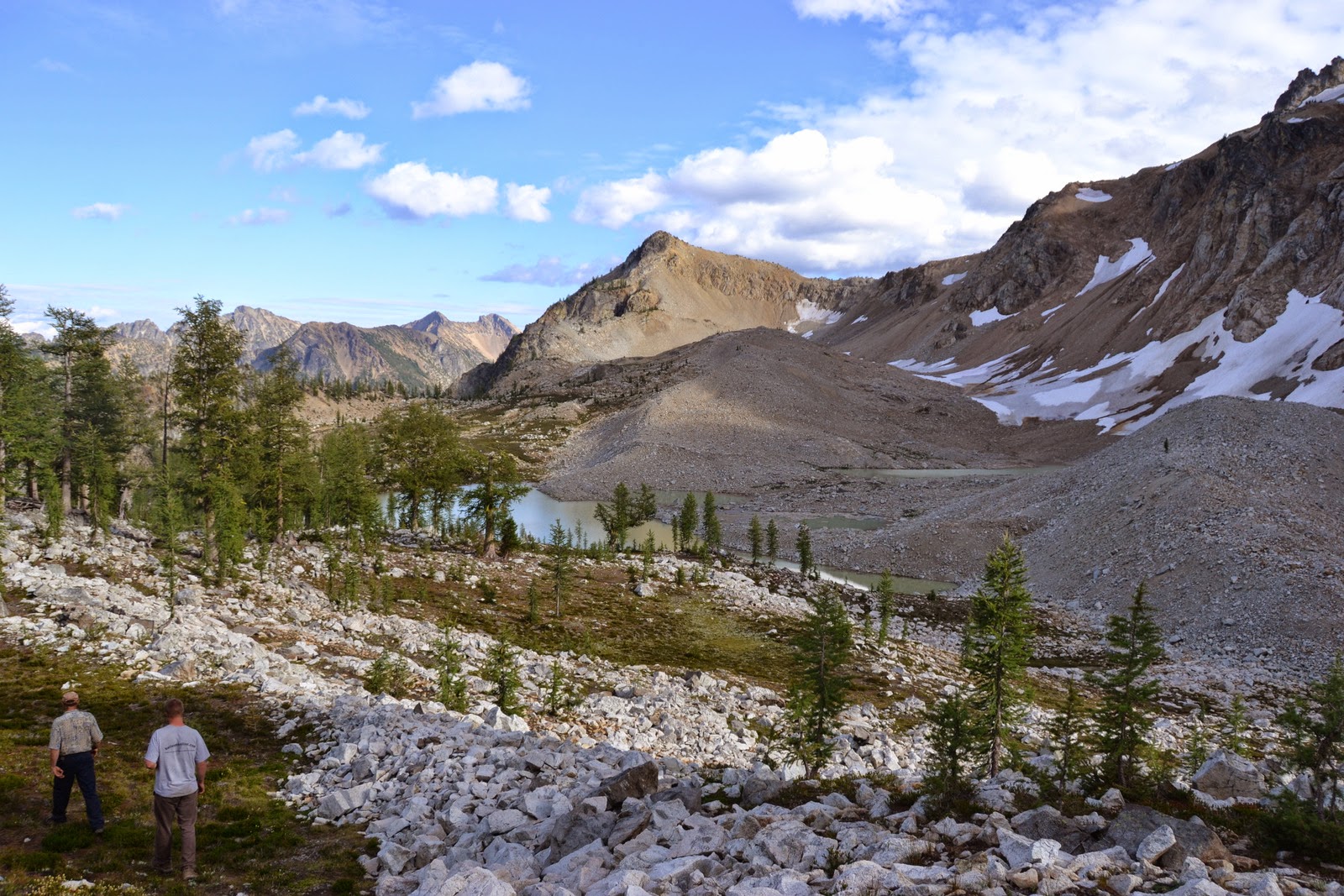
And then, we entered an area of lovely streams and gentle grassy basins. When we reached one such place, Mark said, "I think we should camp here!" Colter and I didn't argue, but slipped off our packs and took in the beauty of the spot. After a rest, snacks, and a coffee break, we were ready to leave our packs behind and see what lay beyond the ridge above. There was still one more steep pull to get up the hill, but beyond that was an expanse of meadow and stream that delighted all of us. Then we reached the top of the ridge, and beyond that lay Bird Lake, tucked under the shelter of the rugged Devore Peak.

To the other side lay White Goat, and beyond that, Tupshin; across the valley we could see the Sawtooth range.

Behind us, over our gentle ridge, we could see Bonanza, McGregor, Agnes. We talked about not going down to the lake, but then kept going, down the gentle slope, around the lake, out on various little viewpoints. It was hard to leave, but the sun was hiding behind Devore's jagged ridgeline and there was a cooling breeze in the exposed areas. Our foil packets began to sound quite tempting, so we turned towards camp. It was easy going across the basin, and though the steep stretch on the other side seemed longer than it had on the way up, we did reach camp with plenty of daylight left for cooking dinner.

While the packets sizzled on the coals, Mark set up a tarp for shelter -- though the sky was clearing again, he decided it would be better to set it up before bed than in the middle of the night. But he set up his bed in the open, for better star gazing. I found another little grove of trees for my bedroom, and Colter decided to set up under the tarp. The foil packets were satisfying and delicious, and it was also satisfying to remove that much weight from our packs.

We talked around the fire a bit, but as the first stars came out we made our way to our nests and settled in for the night. I had one visitor -- a buck who apparently wasn't expecting to find me, judging by the quick crashing escape he made when he discovered me. But we all slept well, and the night was quite mild.

The next morning dawned clear, glorious. Morning camp routines of fire, coffee and tea, breakfast, washing up, and packing were completed. The day was upon us and we were eager for the adventures it would bring! We began by heading back up the hillside towards Bird Lake, leaving our packs in camp.

Once at the top, there was talk of bagging a peak. Devore and White Goat looked a bit rugged, but perhaps we could travel along the ridge to Tupshin? We headed that way, stopping to savor the new views that peeked out from behind each rocky outcropping.
In front of Tupshin

Colter did a little scouting and found that there was a fairly impassable vertical stretch along our ridge, so we decided to leave Tupshin for another day and headed back to summit a hump on the shoulder of White Goat.
 Mt Baker

 Bonanza

 Devore & Bird Lake

The views it provided were not too shabby, either, and we headed back to camp happy. We reached our packs about 10:30, and puttered about camp for a bit, packing up, snacking, resting. Then it was time to load up again and strike out to blaze our new trail.

From above, Mark had looked down at parts of the route he thought we would travel and planned our course, through that strip of timber around the nose of that ridge right over to Blackberry Creek. We encountered a bit of brush, but the boys were still joking about impending blizzards, stinging nettles 10 feet high, bugs, darkness, and other disasters, so I knew all was well. The brush thickened, and it was hard to see the bigger picture of where we were headed and what the best route was. We would come to a sort of lookout, and look out to see timbered hillsides descending steeply to one side, and thick brush to the other. "Another drainage -- do you think we should go high, along that timber, or cut across here?" Down we went, then it would look more promising farther up the hillside, so we'd climb up till we reached some impassable bluff, then down again through brush that seemed to thicken the farther we went. We would lower ourselves down while clinging to fir branches and brush, scrambling over logs and rocks. At one point I asked Colter what one particular bush was that we had encountered quite a bit of; it grew out horizontally from the hillside so that some of its strong, pliable branches could trip your feet while others slapped you in the face. "I don't know; I bet you could come up with a choice name for it right about now!"

I lost track of how many times we rounded the nose of a ridge only to see there was another gulf to cross before we reached the elusive Blackberry Creek. There was talk of going back the way we had come and heading down to Company Creek, but none of us really wanted to recover all the ground we'd crossed so far. After lowering ourselves down one slightly sketchy section of rock, Mark said, "Well, we're not turning back now!" Instead of joking about how terrible everything was (or was about to become), the boys began to point out the good things about where we were -- at least it was cool deep in the brush, and we were making progress, and there's always a way, even when it looks like there isn't.

Once again we came to a decision point; the contour line we were following would take us deep into another gully before bringing us around to the point of the next ridge, and we didn't have enough hours of daylight to add those miles to our trip. So the options were to head up to the top of the ridge and follow it, or to plunge straight down (loosing the altitude we had only just gained) through a steep sea of brush, hit Company Creek, camp along the trail there, and head home on the trail in the morning. I didn't cast a vote; I trusted Mark and Colter to make a good decision for us. But I was getting tired. I noticed my thighs and ankles weren't quite as ready to steadily hold my weight when I headed steeply down, and I wondered how long before they gave out. Mark noticed I was getting tired (probably because I wasn't right on his heels anymore), and asked me if I wanted to use his poles. "I don't know," I said, meaning "would they help at this point?" and "I don't want to take them from you!" But then I suggested that maybe we could each use one, and that did help. The next time Mark looked over his shoulder he noticed the tipsy way I was walking and asked if my feet were sore. "No," I answered, "My muscles are just tired!" (To put it mildly.)

"I can take some of the weight from your pack," he said, and suddenly he and Colter were both standing there with their packs open wide, taking whatever I handed them. "I can take your sleeping bag." "I can take your water bottle, too, Julie." I had been close to tears, and their gentle kindness brought the mist to my eyes.

With my pack considerably lightened, we set out again. The skies were clear -- it truly was a glorious day -- and the sun burned hot. We drank thirstily at our breaks, and filled up our bottles when we crossed little creeks. My muscles were still wearing out, but I told them there was no option to quit here, and prayed for the mental strength to continue. At last the sun left the valley, but the evening was warm and we were still glistening with sweat. When we would take off our packs, I would always find a deposit of fir needles on the back of my neck from the branches we had plowed through.

When we had decided to head straight down the ridge to the creek, we were probably about 3000 feet from the valley floor. Our progress wasn't fast, but it was steady, and when we would get a peek through the trees, we could see the bed of Company Creek approaching. Then we began to hear its roar. The brush continued, and Mark seemed weary too, slipping more often on the steep terrain. Colter was steady behind me, moving a branch out of my way when he could, always close on my heels but never complaining that I was slow, quietly cheerful. We were almost to the creek when Mark suggested that we could camp there, instead of fighting the last of the brush and crossing the creek that night. The choice was mine, and I wanted to go on. We ducked and squinted and climbed and slid through the alders, cedars and devil's club at the creek's edge, and then I saw the water through the leaves. Lovely sight!

Mark investigated a log upstream, but deemed it unsuitable and came back to where Colter and I were waiting and where we would wade across. The boys just plunged in in their boots, but I took mine off to go barefoot. Colt took my boots, and Mark stood in the current waiting for me so we could go through together. It was just shy of waist high, and in the thick of the current it was a good thing he was hanging on to me, or I wouldn't have kept my footing. Colter followed behind, so that when I slipped on the slick rocks in the shallow water he and Mark were both close at hand to reach out and steady me, keeping me upright. We had made it across! A little revived by the refreshing water, and the knowledge that a trail was close at hand, I patted my feet dry and put my boots back on, first emptying out pine needles and leaves. Then we charged into the brush once again, but it wasn't long before Mark gave a triumphant cry and we were tramping along the trail. Our pace smoothed and quickened, and we skimmed along the trail as dusk fell on Company Creek valley. I think it wasn't more than a mile when Mark called to us again and we knew that we had reached Cedar Camp, our home for the night. All of us were quite ready to call it a day. Colter was dreaming of his Backpacker's Pantry Beef Stroganaff; I said I was dreaming of a bench. "Good luck with that," he said. "I'm not picky!" I responded.

As we poked around the camp, we found, towards the creek, a lovely area under a vine maple and alder ceiling with a fire pit at the center and, just as I had requested, three benches. Mark got a fire started; Colter gathered wood; I filled the can with water and then headed back to the creek to wash up and change into dry clothes (the bottom half was wet from our wade; the top half was at least as wet with sweat). Mark and I laughed when Colter pulled out his fresh clothes and said with dismay, "I put my clean socks and underwear on the wrong side of my pad -- they were against my back and now they are just as sweaty as the ones I have on!" How delicious those freeze dried dinners tasted! We finished off with cookies and Cliff bars and then, as the fire was dying down, the boys headed back towards the trail where they planned to throw down their sleeping bags. I cozied up there by the dregs of the fire. The night was quite mild, and I sat and journaled for a few minutes to capture some of the day and to wind down for bed. Then I turned out my flashlight and slipped into my sleeping bag. I could see stars winking between the leaves of my roof, and the ground was soft under me. One mouse came dashing by as I was drifting to sleep, but he moved on and I was soon deep into dreamland. I woke a few times to turn over, but slept deep and sweet.

In the morning, I watched the last stars die out, dozed, and then watched the sky turn pale. I turned on my light so I could read Psalm 138, and gave thanks to the Lord along with the writer of this ancient song. "My strength of soul you increased," the Psalmist said. That's what He had done for me the day before, too. "The LORD will fulfill his purposes for me. Your steadfast love, O LORD, endures forever; do not forsake the work of your hands." Part of His provision for me had been in the kind, gentle care and happy companionship of the two men on the trip with me. Soon I heard cracking in the woods and first Mark, then Colter appeared with an armload of firewood. "You even have a fireplace in your bedroom!" Mark told me. Then I had tea and breakfast in bed, too. Quite deluxe! We enjoyed the morning but didn't linger around camp; soon we were all tucking wet clothes and our sleeping gear back into our packs. At 7:03 Mark was hoisting the last pack onto his back as we stood in the trail. It wasn't hot yet, but the morning was certainly mild, and the clear skies promised that soon the day would be toasty.

We limbered up our well-worked muscles and Mark set a steady pace down the trail, under and over occasional logs and between gentle arms of brush. But it was easy traveling after the day before. There were a few songs, jokes, and words between us, but mostly quiet camaraderie as we tromped the final descent to the Stehekin valley. We passed Jonathan and his dogs out for their morning hike. The trail flattened out, and I knew the road was close at hand. And then, we could see the red truck, and Logan, driving by. Civilization had returned. Though none of us were sorry to offload our packs and take a seat, neither were we sorry for the trip we had set out on, or the adventures we had found.



Tuesday, June 17, 2014

What will you do with a moment or two?

It's easy to take care of those free, empty, in-between, too-tired-for-anything-else moments by opening the lid of my Pandora's Apple and chasing one rabbit trail after another, whittling down my email inbox, checking Facebook, reading an article or two, browsing recipes, updating my Etsy shop, skimming blogs, importing photos from my camera... I'm never "done" on my computer, and most things I do there require little creative energy or serious thought.

Most of these things are useful, and I don't think it's necessary or wise to give them all up, but if I keep the lid open for less time, I can still accomplish all that is important, and then what can I do with the time that is suddenly on my hands?

I can read -- right now, "Amazing Grace," a biography of William Wilberforce by Eric Metaxes. I'm inspired by the way his conversion to Christianity in his twenties completely reshaped his priorities and the way he spent his time. He thought it mattered how a Christian filled the hours in his day, and mourned the days he had wasted in parties, concerts, dinners, and idle sparring with his friends.

I can make music -- not only does it sharpen my mind and muscles to practice the mandolin, but I can be creative (a trait I received from my Maker) and I can use music to worship Him, on my own and with others.

I can write letters -- I can give someone the gift of taking time to nourish our relationship.

I can spend time in the Word and in prayer -- why is this not where I automatically turn with the in-between, discretionary moments of my day?

I can run -- this keeps my body healthy and also refreshes my mind, giving me time to take in the beauty of the day, pray over and release whatever is on my heart, fix my eyes on Jesus.

I can create -- I can sew or paint or dye scarves or make a card. Besides producing something that is often both beautiful and useful, creativity strengthens my mental abilities and satisfies and grows my soul.

I can look someone in the eye -- I can be present with others in the room, converse with them, ask a question or share an insight or just show that I am available. 

I am glad for the change of surrounding and schedule this summer that makes me newly aware of the time I've been given. I am faced with a clean slate upon which to etch fresh daily habits and routines. I still think my computer has its place. But right now I think I'll close the lid and spend some time reading my book!

Tuesday, May 20, 2014

Everyday Adventure

The sun was friendly that morning, with a melting warmth that didn't scorch, so welcome and freeing after the months of sweaters and boots. Midday Mom and I set out to cross Lake Washington, skirt around Lake Union, rumble across the Ballard Bridge over the Lake Washington ship canal, and tool up Market Street to Portage Bay Cafe. We found a booth across from the open kitchen where we could watch the chefs chop and stir, and slid into our seats. The menu tempted us with the berry filled breakfast bar, shallot jam, rustic toast, and house-smoked salmon. At last we made our choices and were soon served aromatic plates full of hearty brunch fare, a scrambled egg, shallot, & tomato grilled cheese sandwich for me and a sweet potato Brussels sprout frittata for Mom, both heaped with fresh peppery arugula. As we ate we talked about our coming summer apart and our plans and goals for the months ahead, memories of Mom's childhood, recent insights, and random girl chatter.

Appetites satiated, we went back out into the sun and decided to walk to the Ballard Locks, which we thought were close by. After a short meander we found they were indeed just around the corner from the cafe, and entered the English gardens on the grounds of the Locks. Trees and shrubs were in full May glory, and our pores were open to absorb the beauty of the moment. We trip-trapped across the walkways over the canal: large lock, small lock, dam with smelt slides (where the gushing water sent up a cool cloud of mist), fish ladder. A cruise boat entered the small lock while we watched; the gate closed behind it and the boat gracefully sank deep into the cement cage, then the gate on the other end opened and the boat motored out into Puget Sound. We walked back through the gardens on a different path, then returned to our car. But the day still beckoned to us, and we didn't drive home yet.

We drove slowly along Market Street, looking for what might catch our eye; then Mom said we were close to the church where she and Dad were married, so we turned up the hill and she followed a hazy instinct that led us off the busy thoroughfare and into a thicket of residential streets, right to a stone building with wide steps leading up to the front doors. We stopped and looked and I tried to see them as they were almost thirty-eight years ago; she texted Dad a picture of the church.

Back on Market Street we circled, looking for a place to park so we could peek into some of the shops and side streets. We slid into a shady spot and headed down an angled street lined with brick buildings filled with curious combinations of pubs and boutiques. The first store to lure us in was a new-and-used outdoor gear shop, where a rack of discounted sample garments yielded a new dress. I couldn't pass by the Fresh Flours Bakery, either, so we went in to let our eyes linger over the case, nod appreciatively when the counter help informed us of the great skill involved in making French macarons, and order iced tea, Jasmine green and a house brewed chai latte.

We were still crunching our melting ice as we made our way back over the Ballard Bridge, along the edge of downtown, and onto the freeway in the thickening afternoon traffic. As we picked up speed, we rolled up the windows and switched on the AC. We returned home where the lists and routines we had left behind were waiting for us, but our timeless day nourished souls that rightly long for something beyond schedules and duties. 

Tuesday, May 6, 2014

Making Music

When we had gone back for seconds, and our plates were emptied again, and conversation was easy, and the children were getting restless, we pulled out our instruments, right where we were on the covered patio, with the lavishly blooming lilacs for walls. There was a general twanging and humming as strings were stretched to the perfect pitch. Snatches of song from fiddle, mandolin, and banjo vied for preeminence as the children's voices had done a moment before, until the mother announced a title and strummed the first chords on her guitar, drawing the others into her song.

The only sister among a passel of boys sat beside me, both of us playing the mandolin, she with skill and grace, me a beginner, my fingers still learning the frets and chords. "G," she would say, looking and me and smiling, letting me know the key of the song. I watched her easy fingers with delight, and did what I could with my surprised and recalcitrant digits.

I'll Fly Away, Amazing Grace, When the Roll is Called up Yonder, What a Friend We Have in Jesus, Turn Your Radio On, Come Thou Fount -- we rolled from one song to the next, the interludes often filled with "Swing Low, Sweet Chariot" from the mandolin while the banjo was still hammering away at "I'll Fly Away" and the fiddle was racing off with a bluegrass tune. At last we would decide on something, and the singers would find it in their hymnals, and once more the disparate notes would slide into unity.

After we sang a few verses, often the fiddle would take a turn, flying over the melody with a touch of whimsy, a wash of grace. Sometimes the banjo would come in for a solo, leading in with a flourish and shining at every opportunity to ornament. The mandolin beside me only broke loose under cover of one of her brothers, when she thought she could blend in.

The two little boys, not yet ready to join the jam sessions, wandered in and out among the instruments and singers, one quiet and unobtrusive, the other walking where he pleased with a swagger and making up for it by bestowing his sparkling smile liberally on all.

We sang "In the Garden" for the children's grandma, and put our instruments back in their cases as the colors of the sunset faded over the lake. The gift of the music lingered with us, but for the children, the evening was not complete without a rousing game of "monkey in the middle," played with a foursquare ball and much laughter in a narrow courtyard. "Julie, do you want to play?" asked my fellow mandolin player. How could I refuse?

Wednesday, April 30, 2014

Summer Foretaste

It's still April, but yesterday felt like summer. Mom's ladies' group was meeting in our home in the evening, so Dad, John, and I were expected to keep a low profile. I was in the kitchen when the ladies arrived, finishing cilantro rice, venison stew seasoned with lime and chilies, and avocado slaw for the boys and me. Mom had a pot of soup on the stove, too, for the women. They entered to savory smells and the clatter of pot lids and girl chatter, dressed in sandals and a bouquet of eager summer colors: peach, mint green, turquoise, pink. There were hugs and greetings while one lady unpacked her warm berry crisp and vanilla ice cream, tucking them into the oven and freezer to hold them at the perfect temperature. Another brought calla lilies to Mom and her sister, a token of thanks and of summer. They noticed John's starts, bending eager stems towards the big dining room window to soak up the light, and we talked about his farm plans and how they could get in line to buy his produce.

As the ladies dished up their soup and settled around the table, I checked my rice one more time and decided the boys and I could eat, too. I found them setting up the electric fence around the beehive, in preparation for protecting the inhabitants that would arrive on the morrow, and asked them to ready the picnic table. They carried it to a discreet location, away from the dining room window, and wiped the pollen from table and benches. Then we ferried the food and place settings out to the table from my staging area in the laundry room and dug spoons into our steaming bowls.

The chickens hemmed and hawed in their run behind the garden, wild with garlic and miner's lettuce and happy spring weeds. The grass, freshly mown, was bright and soft under our feet. The boys talked of farming equipment and bees and baseball; I listened in (they were talking about the Yankees vs. Mariners game, and Cano, who recently moved from the former team to the latter) and contemplated the robust rhubarb plant and what occasion was coming up that would require the baking of some kind of pie or tart or cake or muffin.

I remarked that ice cream would be an ideal finish to the spicy venison stew, and John reminded me that we had some in the freezer left from Tim's birthday celebration. But the ladies had now started their evening, and how could we retrieve the ice cream without disturbing them? The boys agreed that on the basis of my gender, I was the one for the job, and I began looking for an opportunity. When we heard the clink of dishes inside indicating that the women were in transition between table and living room, I made my move. I slipped into the kitchen in the midst of dishwasher loading and food clean up, fetched the ice cream, and returned to our quiet picnic. It was the perfect finale to our meal, and we savored it, lingered a bit more. But the sun, while still lighting the sky, was long gone from our tree-guarded yard, and the ice cream accentuated the cool of the evening. So, we filed quietly into the laundry room with our stacks of dishes, and the boys returned outside to finish their fencing while I slipped upstairs to put away things from the day, and to prepare for the next day and the night of rest. 

Wednesday, April 23, 2014

Curious

Early on in the Good Friday service Annie pattered down the pew to me. We didn't need to exchange words; I knew she was coming to sit in my lap, and she knew I would scoop her up in my arms. But the silence didn't last long.

She wanted to know where Papa was? I told her he was sitting in one of the front pews so he could get up when it was his turn to read. But then she wanted to know where are the front pews? Where IS Papa? She looked through the bulletin. "Which part are we on right now? Which part is Papa reading?" I told her we would have to wait and see.

So she turned her mind to other questions. Why are there candles? I told her the candles bring light, which is something that reminds us of who God is. "But God is not in the light," Annie told me, eyebrows peaked in confusion. "He is in the mountains!" I wasn't sure where this idea was sprouting from, but it wasn't really the right time to delve into a long explanation.

She wanted something to play with, but I had nothing. She was feeling chatty but I told her it was time to listen to Pastor Irwin, who was going to talk to us for a little bit. She was quiet for a moment, then thought of another burning question: "What is an Irwin?"

Pastor Irwin finished his short homily, and Annie was listening to the readings now. "What is 'guilty'?" she asked, picking up on a word she heard. "What is a vow?" And then, "Why did she say, 'eating body and blood'? We don't eat blood!" I told her that Jesus told us to eat His body and drink His blood. "But we don't like blood!" she protested. Well, no, but we need Jesus' body and blood to feed us. "But we don't eat his whole body, do we? We don't eat his tummy, right?" I explained that it was like a picture -- we don't eat His actual body, but He gives Himself for us and we need Him to survive. "Oh, Nana showed me a picture of Jesus dying on the cross," said Annie, at last finding a word in my mysterious whispers that she could relate to. "But we don't eat blood. We don't like blood, because blood is too spicy."

During the songs, Annie's hearty whisper disappeared, and her volume climbed. I asked her to be quiet, and she seemed shocked at this request. "Why do I have to have a quiet voice? I want to sing with you!" After all, everyone else was allowed to make noise. So I began telling her the next phrase of the song so she could sing it along with me. Then she would announce after she sang a phrase, "I sang 'mingled down' with you! I sang 'rich a crown' with you!"

She also noticed the ways people around her were participating in the song. "What does it mean when we close our eyes?" she asked me. I told her it meant we were thinking about the words of the song. Her follow-on question was, "Why are mama's eyes closed?" 

As the evening went on, the lights dimmed till we were sitting in darkness, apart from the light shining on the cross and the candles, which were being extinguished one by one. Annie was interested in this, and took note that we could still see cracks of light coming in through the blinds, the last bits of daylight and the shining of the streetlight in the parking lot.

Then, we came to the point in the readings when Jesus died. We sat in darkness, and a drum began to beat a wild, accelerating song, evoking the earthquake that shook the world at the death of its Maker. All the people were silent, except for Annie. "What is that noise?" she whispered to me, and I told her it was a drum, reminding us of the earthquake after Jesus died. I wondered if she would be scared of the unfamiliar noise in the darkness, but a grin began to form on her face. "That is a silly noise!" she said. And as the drum faded into silence, a giggle began to bubble from little Annie, which I quickly hushed, not wanting to disrupt the story, the mood, the remembering we were all partaking of together.

Easter Sunday morning found Annie and me together again in the pew, this time as the church was filled with light. Annie was still filled with questions. "I want to see Jesus dying on that cross," she told me, looking to the front of the church. She was apparently aware that the cross was somehow central to the celebration, and she kept returning to it. "When will Jesus die on the cross?" she asked. I told her He already did! "But when will Jesus die on the cross again?" Never, Annie, never again. "Is that the cross that Jesus died on? Why did Jesus die on the cross? What is that lellow thing on the cross?" No it isn't the cross Jesus died on, and He died so that we could live, and that lellow thing is a white cloth representing Jesus' grave clothes that he left behind.

Her curiosity also extended to God. "Why can't we see God?" Because He is a Spirit, and just because we can't see Him doesn't mean He isn't here. "But I can't SEE Him!" She kept repeating this, working it over in her mind, and then a few minutes later I saw an opportunity. The door was open, and a breeze slipped in. Annie said, "I feel the wind blowing my hair." I asked her if she could see the wind. "Yes," she answered. "I see the wind blowing in the trees." Well, maybe it takes time to understand the idea of a spiritual world. But she did ask me if God was a man, so perhaps she has an inkling that there are real beings who aren't men.

And, when she was not fixed on the cross, she was watching Daddy. "Look! Daddy is playing his trumpet!" I told her it was a trombone. "No! It is a trumpet!" she insisted. Well, I told her, it's actually a trombone. "Oh, a trumpetbone," she said. When I smiled at her she got a twinkle in her eye and said by way of explanation, "I call it a trumpetbone." Okay, I agreed. Later when she was pointing out that Daddy was taking a break, she said, "Why is Daddy not playing his bonetrumpet?"

May I be as bold and earnest in my curiosity, in my observation of the world around me, in my quest for truth. And Annie, may you know the truth and be set free by it.

Thursday, February 13, 2014

Looking for Something to See

We watched a photography lecture last night, in which the instructor told us there were three important elements in an iconic photograph: great light, good composition, and an interesting subject. To put these together in a photograph, he told us, you have to learn to see.

This is what it means to be a writer, too. The subject has to be interesting; you have to have something to say. The composition or structure must be sound, fitting to the subject, creative, not distracting from what you are trying to say. And light -- what is a writer's equivalent to light? It is that which enables us to see, and the way it falls on our subject affects how we see it, and determines the voice with which we tell our story. The dawn of a new day allows for one kind of vision; midnight starlight quite another. In the bright and busy light of noon all is visible, but distraction abounds; twilight cloaks many details in shadow, narrowing our focus.

The photographer and the writer both find their best fodder not when they travel to exotic destinations and participate in extreme adventures, but when they learn to see what is going on in the every day. Each time the sun rises, there is something unique and fresh about the way its light falls on the earth; this is what makes art, what makes what I see different from what everyone else has seen, what gives me something to say.

Each morning when I am running in the woods and I round the corner into the clearing and climb to the rise where I can look past the forest to the west, I am eager to see what is there. Is the moon being swallowed up by the mountains? Is Seattle gleaming like the celestial city, throwing back the rays of the rising sun? Are the mountains blushing rosy under the steadfast gaze of the sun, who is like a bridegroom coming forth from his pavilion? Are the clouds tucked in close and grey over the mountain range, or hanging low and fleecy white in the valley? What colors and clouds are painted on the living canvas of sky, sometimes displayed only for the blink of an eye? Like the mercy of God that is new every morning, so there is something new for our eyes to take in with each new day.

I wonder if this is part of what it means to live in hope. Paul says "the creation waits in eager expectation for the sons of God to be revealed," which says to me that these sons have not been revealed yet, that there is something yet coming, something to wait for. Paul also tells us that God "chose us in [Jesus] before the creation of the world to be holy and blameless in his sight.... In him we have redemption through his blood, the forgiveness of sins, in accordance with the riches of God's grace that he lavished on us with all wisdom and understanding." We are already chosen, redeemed, lavished upon. Yet still we wait.

The cycles of waiting and fulfillment that we live with on earth -- waiting for sunrise, for the birth of a child, for the coming of a desired event -- echo the way we wait for perfection as God's children.
The fulfillment we receive now, the mercy that is new every morning, is a foretaste of the time when all the promises will be completely fulfilled.

So I will wait in eager expectation for that final day, and in the meantime I will keep looking for pictures to take, for stories to tell, for the new way that light dawns each morning. 

"O Israel, put your hope in the LORD, both now and forever." Now, today, even while I am waiting. Forever, when that hope will be sated. 

Scriptures from Romans 8, Ephesians 1, & Psalm 131

Tuesday, January 28, 2014

One Quiet Moment

The children have been with us for a few days, and yesterday was a busy day with them. Get everyone dressed, convince them that they really do have to go potty so I'm not cleaning up accidents later, take the girls for a piggy back run in the yard to pacify them when they learn they can't come with me on my run, get everyone to the breakfast table, try to make Lucy eat her eggs before her banana bread and police Annie so she doesn't eat the entire basket of oranges, clean the house while arbitrating Lego play, explain to Peter that I can't help him set up a tightrope for his Lego car right now, join Mom in the hall to deal with a lying episode, extract Annie from the older kids when she gets fussy and set her up playing in the living room while I vacuum downstairs, answer her when she asks which cup goes next on her tower, get everyone fed again, tuck everyone in for a nap or quiet time, convince Peter that Lucy doesn't need a container of water for her nose bleed, convince Lucy that her nose is not bleeding anymore and there is no emergency, answer Lucy when she yells down the stairs to see if she can get up, tell the kids they can get up, arbitrate and answer questions as necessary, help Peter deal with his disappointment when he is banned from Legos after wrecking Lucy's creation, get dinner on the table while Mom reads to the kids, feed Annie her soup while eating my own, laugh with the kids while we eat pear slices with homemade chocolate and caramel sauce spooned on top, do the dishes with Dad while Mom bathes the girls, answer Peter's bellows from the shower by telling him where his towel is and that he will have to run upstairs to get his pajamas, join everyone in the living room for end of the day devotions, grease up the chests and feet of the three coughing children with a little menthol rub while they wiggle and laugh hilariously at the tickle.

And then, it is quiet. Lucy and Annie both want to sit in my lap, so we sprawl on the couch, damp heads resting in the crook of my neck. They are quiet while Dad reads the Word. When it is time to pray, I fold my left hand with Lucy's right and my right hand with Annie's left. They settle, even livewire Annie, and we pray. Annie is thankful for building a tower with cups; Lucy is thankful for playing with Legos; Peter is thankful for dessert. I am thankful for many things, especially this fleeting moment with my dear ones.

The prayer is over; Annie is proclaiming her desire for a drink and what color of cup she wants; suddenly everyone else wants a drink too. Their hair has dried after their bath, and Annie's hair rises like a lion's mane, matching her rising voice. The moment has passed, so I treasure it away and look for what this moment has in store.

Thursday, January 16, 2014

What the Dawn Reveals

Yesterday when I woke I opened the curtains in my room to see what the morning was like. I am housesitting this week, so the view out this window is not part of my daily routine. It was dark, but I left the curtains open so that as I read the Word and journaled, I could watch the coming of the day.

The sky began to lighten, revealing the dark hulk of Mount Si. The more the sky glowed, the blacker the mountain looked. From milky pale at the horizon, where it gave sharp definition to each crag of the big rock, the sky faded into brilliant glowing blue and then to midnight navy.

No sooner had the sky flattened to winter white then the sun reached up and brushed the undersides of all the stippled clouds with pink, now highlighting the snowy peaks of the farther, higher mountains.

Today the coming of the sun could not reveal the mountain, lost as it was in a sea of fog. In the fog I went for a run; still, at midday, I look out the window at a grey that erases all I know is there. Only the spiny branches of the naked winter trees close at hand are sharp, the fog a backdrop for their lacy limbs.

Tuesday, January 7, 2014

Eyes to See

It's not that some days there are no needy people in my life. It's just that some days I have eyes to see.

On Sunday I asked a girl if she would be heading back to college soon. It was classic small talk; she said, "Tuesday," and I said, "Are you looking forward to it?" and she said, "Yes," but it was just a facade, and her mom said, "It's a lot of hard work," to fill in the conversational gap and help express what her daughter wasn't saying. I asked if there were some things she was enjoying about school, and then I looked up and her beautiful brown eyes were shimmering with tears, her smile apologetic, as if to say, "I didn't mean to fall apart right here, right now." Of course she didn't; no one wants to fall apart, and she doesn't know me well, so why would she want to bare her soul to me? But we are all falling apart sometimes, and the veneer wears thin. We fight to keep it in place, but it is when the veneer is thin that relationship happens. I touched her arm, grateful for the connection, aching for her. "I will pray for you."

She's always chatty and smiling, buoyant. But when she walked up to me on Sunday and was asked how she was doing, she told of being sick in bed all week with no symptoms other than a rash and utter weariness, a complete inability to get up and care for her family. When she went to the doctor and checked out fine physically, the doctor's diagnosis was depression. "But I don't believe in depression!" she told us. "I'm not a depressed person." Yet, at the intersection of leaving her longtime home, wrenching family troubles, and the end of a sweet season of Christmas togetherness, she was left feeling rootless and lethargic. What is the point of going on, she wondered. She is battling against it, but the pain and the apathy are real and present for her in this season.

"I hope I'll be able to get a nap in," another woman confided as she discussed the Sunday afternoon schedule. Her health is fragile and her energy carefully rationed, but she was going from church to lunch at a friend's house to hosting a group in her home that evening. The day before she uncovered serious behavioral issues in her daughter, revealing serious heart issues. She shared gratefully about receiving wise counsel and encouragement from unexpected sources that morning, but still, the enormity of the task before her -- shaping this broken girl's heart -- looms larger than her strength or resources.

Each Sunday at church, each day I go to the grocery store or to a friend's house, the real, needy people are there. I am so quick to be smart and superior, to categorize and criticize and even make a joke about the shortcomings of someone else. But sometimes, God gives me eyes to see and I cannot forget the beautiful, excruciating sight of these hearts. May I live humbly that I may see more often.

Wednesday, July 10, 2013

Running the race

We milled in the crowd lined up on Tolt Avenue behind the big red arch that marked the start of the race. Dad, Mom, and I all wore numbers indicating that we were registered to run in Carnation's Independence Day 5k. Other runners jostled our elbows and toes; we jostled back as we tried to determine our pace and where we should line up. The pace markers backed up to make more room for the runners; Mom edged back to stay with the 10 minute mile runners while Dad and I stayed up with the 8-minute-milers, but none of us were sure what our pace would be.

As we chatted on the sidewalk before lining up, Mom mentioned Grandpa and said, wet-eyed with a choke in her voice, "I could cry, thinking about him!" He would have loved to be there, running a race with his family, cracking jokes with strangers, making us laugh with silly jigs. It was easy to imagine him with a number pinned to his t-shirt; he ran in many races, from family 5ks to marathons. He would train with his tomato-red knit hat on to keep his bald head warm, and stop at the gas station for coffee and to say hello. On race day, it wasn't about winning but about working hard and about the people around him, always about the people.

He often lined up at the start of a race with grandkids or his son-in-laws or friends, but I don't remember ever running a race with Grandpa (Mom says maybe I did as a very small child, at another Independence Day race in Fort Lewis). In fact, this Carnation Fourth of July event was my first race ever. But as the gun went off and the runners broke free, it didn't feel strange and new; old memories crowded in so close I could feel Grandpa's sweaty hug and hear his delighted cackle and see his the crooked fingers on his raised hands. I swept aside the sweet memories along with the tears pricking my eyes so I could see the pavement and breathe deep and easy.

My legs and lungs felt strong; I edged to the side to pass old men and plump young women and boys with crew cuts. I knew Dad had been right behind me when we started, but I didn't find out till the race was over that he stayed with me for most of the first mile. If a young boy slowed and began weaving in front of me, or a dad pushing a double stroller cut me off, I thought of Grandpa and smiled. He would have been delighted to share the course, interested in the stories of those around him.

When we passed a volunteer shouting out the time at the one-mile mark, I ran quietly by, but I thought of Grandpa and how he would have done something to connect with the man. When we passed a lady pointing out the route at a fork in the trail I thought of him again and imagined what I could have said to her as I instead ran by in silence. When we passed a row of volunteers holding paper cups of water out to us, I was ready; I pumped my arms in the air and said, "Woo-hoo!" just like Grandpa would have done. I waved at a little boy sitting on his grandma's lap and watching the race go by; I grinned at volunteers cheering us on at another corner. I ran the race marked out for me with perseverance, with delight, with intentionality, with eyes fixed outward.

Pounding down Tolt Avenue towards the red arch, I eased into a sprint. The empty spaces along the route filled in and the cheers became continuous as I neared the finish. A row of cheerleaders from the high school -- the announcer on the loudspeakers -- the double yellow line, arrow-straight to the end. It wasn't till after I burst over the line, breath ragged, face tomato-red like Grandpa's hat, and walked a cool-down block and came back to join the bystanders lining the home stretch that I found Heidi, Peter, Lucy, and Annie. They had been there for me, cheering me on, though I was too intent on the finish to pick them out from the crowd.

I joined them and we eagerly peered down the avenue to watch Dad and Mom's approach. Soon we saw Dad; Heidi and I hollered and cheered, but he didn't appear to see us. So when we picked out Mom's form, we turned it up a notch. I lifted Annie and thrust her out over the road, and together we cheered in our last runner for the day.

On the three-block walk back to Aaron and Heidi's house, Peter and I had our own set of races, Lucy on my back. ("Let's go faster, Aunt Julie!" she said, and then laughed when I picked up the pace. "I'm bumping, I'm bumping!") Later Annie wanted me to pin my number onto her shirt so she could be a runner too. As the new generations sprout up, we pass the baton and the race continues. Thanks for running well, Grandpa.

Tuesday, June 11, 2013

There was an altar call

There was an altar call. Not every Sunday, but most weeks. During the special services that were held once a year, there was an altar call every night.

Sometimes no one came, sometimes one or two, sometimes the pews emptied and the kneelers stacked up, rows deep, in front of the altar. The altar was always open -- Pastor Mark made a point of reminding us of that.

I grew up in churches with altars, and they didn't seem like a show for fellow worshippers or a manipulation tool in the hands of power hungry pastors. They seemed like an opportunity to physically engage with what was going on in your heart.

I don't remember the first time I went to the altar, but I know what it felt like in those early years when I received my own altar call: my heart would pound, heat would flood into my face, and I would cling to the safety of my seat until the urge to rise became unbearable. Then I would slip past the knees of my family, lining the pew between me and the aisle, walk to the front of the church between banks of other worshipers, and at last arrive at my destination. The discomfort and embarrassment dissolved as soon as I knelt on the rough carpet, leaned my forearms on the cool, smooth polish of the wood. The humble position magnified my rightful place before Almighty God. The act of obedience reinforced my submission to Him. Maybe I was responding to hearing the Word preached; maybe I was lifting up a burden of my heart to God; maybe I was repenting. There were usually tears, and always relief and joy at being fully and consciously in the presence, in the very arms, of God. Sometimes an arm would land across my shoulders -- someone from my family, or my larger church family coming alongside me.

From the time I was ten until the summer I turned twenty-five, I attended Pastor Mark's church, my growing spiritual consciousness shaped by the altars Jim Parker built. Each Sunday morning we hauled them out of the trailer into the school cafeteria where we met. I've been away almost six years now, and last Sunday I attended a farewell for Pastor Mark as he, too, moves on from that church. "The altar is like God's lap," Pastor Mark used to say. A paradoxical place where the reality of an incredibly intimate relationship with the absolute God of the universe came to light. I'm grateful for that altar that provided a framework for my newly developing relationship with God, and for the altar before the throne of grace, always open to a humble, obedient heart.

Tuesday, June 4, 2013

Why Three Year Olds Make the Best Language Teachers

My German comprehension is okay. Certainly not complete, but with context and body language and a bit of work, I can usually make out the topic of conversation and if it is simple and familiar, follow along pretty well. My speaking, however, lags behind my comprehension, waiting for some world where I won't mind loosing my personality and polish behind a cobbled together string of badly pronounced words in a time and gender crunching mix. So on my latest trip to Germany, as usual I smiled and nodded, getting by with a "Danke" or a softly spoken sentence here and there. When people realize I don't speak German, they smile an apology and avoid future attempts at conversation, or switch to English.

Until Joshua. He is the three-and-a-half-year-old son of my German friends Melanie and Bernhard, and he had been looking forward to the arrival of "Julie" without any thought of what language he would use to converse with me. He spoke in German, looking me in the eye and expecting a response. Even when my response was a confused look, or a grammatically garbled sentence blending German and English, he did not bat an eye or back off. He did not curtail our conversations or switch to English; he just plowed ahead, as three-year-olds do, his vocabulary simple and to the point.

Some mornings he came to my room to visit; alone together we would piece together communication out of body language and our growing understanding of the German language. I showed him pictures of my dad and brother's bees; he responded eagerly, "Bienen!" and followed with a whole slew of questions I was sure I wouldn't be able to answer even in English. He saw my journal and wanted to color, so he ran up stairs (after telling me, "Bleib da" -- stay there!) to get paper and colored pencils and then scribbled away, drawing ... Kuchen! (Cakes) He slid them into an imaginary oven and when they were done, we ate them.

One night he even wanted me to put him to bed. I read him a story in German (I'm sure it must have sounded awkward, but he listened attentively and made no comment), prayed for him in German, understood when he was asking for a last tuck-in from Mama. 

Since Joshua is not the first three-year-old I have spent time with, I recognized some of his habits as those common to little boys everywhere. His constant, "Warum?" after every instruction or explanation his mother gave was not hard to translate; he is in the "why?" phase. When we took a trip into the Black Forest that required an hour in the car, he peppered the way with familiar road trip questions: "Sind wir da? Sind wir da?" (Are we there?) "Wo ist die Schwarzwald? Wo? Da?" (Where is the Black Forest? Where? Here?)

Repetition was also in my favor. One afternoon when we were working in the garden, he went back and forth between the beds where Melanie and I were working. "Findest du eine Nacktschnecke?" he would ask first one, then the other, over and over again. It was easy to understand that he wanted any slugs we might find. (Why he wanted them was not so clear to me.)

I also gave him a few English lessons. Sometimes he would point to objects and I would give him the English name; when he was busy counting everything in German I would follow his lead in English. Occasionally he would try to repeat me. "Pig" was one word that stuck; "pinkg, pinkg, pinkg" he would say, pointing to pictures of pigs. But when I told him the word "peacock," he told me in no uncertain terms, "You may not say 'peacock.' You can say 'pig,' but you cannot say 'peacock.'" 

We laughed together, too, and made up imaginary games, and shared piggy back rides. And when I would make a foray into the unknown world of German, and he would respond with an action or a laugh or an appropriate answer or a knowing look, he gave me the gift of being understood.

He asked several times where my car was, wondering how a visitor could arrive at their home sans auto.  A Flugzeug was a cool way to have traveled, but he couldn't see the airplane in their driveway, either. Maybe sometime he can travel ganz ganz weit across the ocean in a big airplane and come to give me my next German lesson!


Tuesday, April 2, 2013

He Came with Daffodils

Blood crusted her hair on the left side of her head and bloomed bright on the pillowcase behind her. Tubes tangled around the hospital bed, winding to ports on her chest and wrist. It was the emergency room; no one plans to be there.

She had been driving to Applebee's on a run-of-the-mill Thursday; then there was a bang, a crash, a shattering, a jolt. She didn't know what had happened, and there were people asking if she was okay, and glass everywhere, and someone pressing something to her bleeding head, and lights, and medical workers. "Would you call my son?" she asked a woman, pressing her cell phone into the stranger's hand.

And now she was at Providence, scantily wrapped in a hospital gown, propped and prodded by hospital pillows in a tilted hospital bed. Her son, his wife, and her granddaughter had just arrived, and they were asking if she was okay, holding her scraped hands, looking at the newly stitched slice in her ear and the mango-sized colored lump on her leg. The nurse came in, and then the doctor, to fill them in on her condition. Nothing serious, but they wanted to keep her overnight to monitor for possible bleeding in the brain.

Into the crowded stall slipped another person, a vase of vibrant daffodils and lush hydrangeas in his hands. He held them out to her: "Here, I brought something for you," he said, a little shy.

"Well, are you the flower delivery service?" she asked, trying to place him.

A nervous laugh. "I guess today I am."

"Who are they from?" she asked, still not making all the connections. "I guess I have to look at the card."

He didn't know how to answer her questions; he was embarrassed to have to explain his own gift. "I was at the accident," he said.

"Oh, yes, I thought I had seen you somewhere before! I knew you looked familiar. And you brought me flowers --" Suddenly, the tears came as she realized this young stranger had not only stopped to help her at the collision but had followed her to the hospital to make sure she was okay and deliver his compassion in the form of sunny yellow daffodils. "Come here, I need to give you a hug," she said through her tears. His face crinkled with emotion, and he couldn't speak either as he stepped past her family to bend to her side, giving her an awkward hug in between pillows and her IV.

He said goodbye and slipped back through the curtain drawn over the doorway, her blood dried on the sleeve of his grey hoodie from when he knelt by her car and applied pressure to her bleeding head. Her son and daughter-in-law followed him into the hall, not willing to let this remarkable young man go without thanking him, getting his contact information, hearing his story of the accident that was still largely a mystery.

He wept again as he spoke with them, shaken by this close contact with death, with life. He was young, maybe eighteen; bright orange gauges decorated his ears. Where had he been going when he witnessed the collision? When was the last time he had truly connected with another human? When had he last felt that he was needed? What made him call all the area hospitals to find out where one old lady had been taken after a wreck on the highway? And how would it change his life to give a grandma a bouquet of daffodils?

Friday, February 8, 2013

The Frog Prince, continued

And so, they lived happily ever after.

Right? After the princess kissed the frog and he turned into a prince and they got married, they were always happy.

I picked up my cousin from school today since his mom is out of town, and in the car on the way home he told me about the story he is performing in his Speech & Debate tournament tomorrow. It's the sequel to The Frog Prince, and in it we discover that the prince wishes he were still a frog, a life where he had no responsibilities and could do as he pleased.

"He doesn't like being a prince," my cousin told me. "When he was a frog he could swim all day, but now he has princely duties, dragons to slay, and the princess to take care of. He has to do things to please her -- he has to listen to her! The fairy tales lie to us," he went on. "They tell us we will be happy forever, but no relationship is perfect."

I was struck by this young boy-man's perceptiveness about contentment, and I worked to steer the conversation from cynicism to hope. I heartily agreed with him on one thing: no relationship or situation is perfect, and if you are looking to circumstances to bring you happiness, you will never be happy. The question then becomes, is happiness impossible?

"That is why people commit suicide," he continued. They realize they have been deceived, and that nothing around them is capable of providing happiness.

But what if happiness were a choice, not a set of circumstances or a particular relationship? Not a choice to to manhandle my heart towards gladness through all the dark and disappointing days life may bring, but a choice to look to beyond the dark days we experience under the sun. A choice to be grateful for what is instead of gloomy about what isn't; a choice to set our hearts on God's glory instead of our comfort; a choice to embrace the desire for eternity that has been planted in our hearts instead of wrestling to imbue these fleeting days with lasting meaning.

Paul put it this way: "For our light and momentary troubles are achieving for us an eternal glory that far outweighs them all. Therefore, we fix our eyes not on what is seen, but on what is unseen. For what is seen is temporary, but what is unseen is eternal."

Tuesday, October 2, 2012

The Light

El Greco sky last night as I walked home from work in the dark, the moon shining bright behind the wild clouds. Out of the darkness, one light shone across the field, then a second: two headlights, making a way along the road. I made my way along the edge of the field and through the lawn by feel, in the dark.

A head cold had me up in the night last week, making a midnight trip to the outhouse and looking for a spoonful of honey to soothe my cough. The full moon, almost too brilliant to look at, yet so different from the golden light of day, made my shadow crisp, and I felt like a wood nymph, a fairy, as I frolicked down my stairs, out to the outhouse, to the cold room for the honey, and up the stairs again.

Smoke mushroomed up from the Icy Creek Fire again a few days back; on the dining room tables at the Ranch the sun's window-shaped patterns were sunset-red at two in the afternoon, and when I looked out above Tolo Mountain, the sun itself was a fiery red orb behind billows of smoke.

I didn't want to wait till sunrise to run this morning, so I left in the glow and shadow of early morning moonshine. I walked along the field by feel, knowing the path, recognizing the shadows of the gate, the horses, a branch here and there. Behind me, the horizon was pink above the Ranch; before me, the moon was still shining in all her glory, and the stars were out. The gravel road was grey between the dark trees on either hand, and my feet did not stumble. My nose took the lead, picking out a whiff of smoke on the breeze, the scent of fresh-cut pine as I approached the tree Colter cut out of the road last week. Then there were no more stars. Then the deep, beautiful blue of the night gave way to the uncertain grey of dawn. Then the moon was not a living, pulsing ball of light but a see-through scrap. Then I turned around to run home and the sky was almost white and by the time I got home, the sun was golden on the high rim of Sisi Ridge.

"In Him was life, and that life was the light of men. The light shines in the darkness, but the darkness has not understood it. The true light that gives light to every man was coming into the world. The Word became flesh and made his dwelling among us. We have seen his glory, the glory of the One and Only, who came from the Father, full of grace and truth." John 1:4,9,14

"The god of this age has blinded the minds of unbelievers, so that they cannot see the light of the gospel of the glory of Christ, who is the image of God. For God, who said, 'Let light shine out of darkness,' made his light shine in our hearts to give us the light of the knowledge of the glory of God in the face of Christ." II Corinthians 4:4,6

Sunday, September 2, 2012

Used

When he came in fuming, I didn't even think about defending myself or being upset that he was unjustly angry with me. I was cleaning up the kitchen after dinner; he was a guest at the Ranch, checking on his horses before bed.

"Where's the horse wrangler? There's no water at the corrals!" he said, and I started to answer him but he escaped out the door before I had a chance to figure out exactly what the problem was and how to help him. I guess he saw that I was just the dinner cook and didn't have a ready answer, and he went to work on the problem himself, but he was soon back for more.

"There's no water, and my horses have ridden 20 miles today. They need to have water. I'm not going to be passive about this!"

I didn't know anything about the faucet for the troughs at the corral, or where someone was who could look into the problem. But I saw that there were actually two problems: one was a plumbing issue, the other was a matter of the heart. The man was so worked up I could hardly get a word in edgewise to ask clarifying questions or suggest what he might do or how I could help him. At last he said, "If you can't fix the problem, at least give me a couple of five gallon buckets so I can water my horses myself." Well, there was something I could do, so I found two buckets for him and he went on his way.

And he wasn't the only one on edge that night. All afternoon the prep cook had been finding one thing after another that the breakfast and lunch cook had left undone. Butter, mayonnaise, tomatoes, and hamburger buns not stocked; the grill left crusty and greasy. When the offending employee came in as we were cleaning up, the prep cook brought up these short comings. The conversation started out fine -- one coworker approaching another with issues relating to how their jobs overlapped. But suddenly, while I was around the corner in the back of the kitchen, it became personal -- "I didn't know you expected me to do your work for you," and "I can cut my own tomatoes! I just don't like finding empty containers five minutes before dinner." Defensive. They were talking about mayonnaise and hamburger buns, but the real topic was Self. Long after the discussion had ceased to be profitable, I intervened. "It's not a big deal. I think the expectation was that each of you would leave the things you both use stocked for the other one, but it's really not a big deal." They quieted, went on their way.

And instead of feeling like everyone was irritable and I was tired of people, I felt like this was what I was made for. Jesus says we are the light of the world, and where does the light shine but in the darkness? Circumstances of late have pushed me close into Jesus, and I saw the result last night: when I am bumped, Jesus is what overflows. I marveled as I walked home along the picket fence in the light of the rising moon at how fixing my eyes on Jesus completely changed the way I looked at the people around me. They became transparent, and I saw through to their hearts, to their hurts. Nothing looks the same when I have been gazing at Him.

The next morning at church, I was sitting in my pew praying and thinking about a Psalm I had read earlier and preparing for worship. The door opened and someone walked in. Suddenly there was a voice at my shoulder, a man greeting me. It was Mr. Horse Waterer from the night before. "Hey, good morning. We talked last night, remember? I'm actually not all that bad, see?" He was obviously a little uncomfortable to see me in church. I smiled, and said something like, "It's okay; it's fine," and he sat down with his two friends. During testimony time he shared that he had been studying Hebrews. "Hebrews 11:6 says that without faith it is impossible to come to God, but that He rewards those who believe that He is and who diligently seek Him. This young lady over here [gesturing towards me] saw last night that I got a bit irritable about something, but really what I want to do is to seek God." It was a public apology. I was so glad for him that he was able to come before God and also before witnesses and clear his heart. After the service he approached me again. "Good to see you this morning," I said. "We can worship God together, right?" he said. "Yes," I answered firmly, looking into his eyes. He continued: "God has been showing me lately that I can get a bit snippy in certain situations. It just happened recently at a fair we were at, too, and I asked Him to work on me because I don't want to be that way -- I don't like it. And now it has happened again. I guess He needs to keep working on me." "And He is faithful -- He will do it," I answered.

There was something very special about this glimpse into the heart of a stranger, this bird's eye view into his heart. (Or perhaps a God's eye view.) Anyone can walk into church on a Sunday morning wearing his Promise Keeper's shirt and talking about the faith, but it is a rare and beautiful thing to see the conviction of the Holy Spirit in action, to see humility and honesty and a hunger for God.

And so, I will continue to pray a little prayer I have uttered countless times in the past years: "Use me for Your glory." This summer, at times, I have felt like He used me up. But there is a cycle: when I get empty, I am forced closer in to Jesus to get filled up. The closer I am, the more He can use me, and the more I see people as He sees them, and the greater my love is for them, and the more vulnerable I am to being used and used up. And then the closer to Jesus I have to go.


Thursday, August 2, 2012

Now We Are Two?

The sun was not yet shining in the valley when I woke yesterday morning, but the sky above the mountains was pale and clear. I enjoyed sweet time in the Word before getting up and dressed for the day -- my 30th birthday. It was not to be a running morning - Mistaya had plans for a birthday breakfast down at the lake, and I had to get the grocery order in before we left. So I headed over to the Ranch about 6:20 (exchanging good mornings with Mark in the yard and receiving a birthday hug from him), joining Gordy in the kitchen as he prepared breakfast and I took inventory and decided what we needed for the week ahead. I always enjoy tidying up the kitchen corners and taking stock of what needs to be used, so it was a pleasant hour and a half. The first birthday card arrived from one of my co-workers, and I had already received my first birthday email from my brother-in-law, who was working late and thus awake for the inaugural moments of August first.

By 8:00 I was done with my morning duties and ready to head down the road with Jake and Mistaya, who were up visiting for a couple of days and so kindly arranged a little celebration for me. When I went into the house to meet them I found a gift from Monica on the table: a bouquet of fresh-cut flowers, a thoughtful card, and a beautiful handmade apron. We loaded into the pick-up cab, and John hopped in the back, and we chatted as we drove to the bakery. There we picked up what Mistaya had ordered: a special quiche and apricot-hazelnut rolls. Samantha and Dawn and her 3 children met us there, and we caravaned down to the lake. McKenna could hardly wait to get out of the car to hand me the sweet card Dawn had written to me. She wondered if I was turning two like she is two. We spilled out onto the log office lawn, pulling chairs into a circle (John found a big king chair for me) and breaking out the bakery treats. The children delighted us with antics and smiles, and we lingered as the sun rose high enough to reach our patch of grass and warm our skin.

At last we broke up our circle -- John had to start working at the bike stand, Jake and Mistaya had to catch the boat, I had to head back up the road to go to work. Before I left the landing, I stopped by the post office and Jonathan handed me a birthday package all the way from Germany.

At home I got ready for work and read my cards and emails. After lunch I put on my new apron and got busy in the kitchen preparing for about 70 dinner guests. Brittany and I chatted as usual as we worked, and the afternoon slipped quickly by. Monica brought us root beer floats on her way home from work, and the cold treat perked us up and made us feel very celebratory. I made a chocolate cake with fresh raspberries squashed into strawberry cream cheese frosting for the filling, and decided it was my birthday cake. The dinner hour came and brought 81 hungry guests, so Brittany and I were kept quite busy trying to fill them all up, especially once we ran out of pot roast (somewhere around guest #64). I think everyone went away satisfied! Then we fed our faithfully hungry and grateful crew, and at last we were able to eat, and there was even a piece of my birthday cake left for me.

John helped us finish cleaning up in the kitchen, and then we walked home together and he gave me a little gift from Dad and Mom and we chatted (and I read more birthday emails) while we waited for Mark and Monica to return home from Bible study. When they arrived we talked about our day and had a sweet time of prayer together. What better gift can I ask for than the heartfelt, sincere prayers of my friends? Though Mark told me there were still 2 1/2 hours of birthday left, we decided it was time for bed, and I tucked into my sheets just as the large, bright moon was slipping out from behind the ridge. I lay counting blessings for a long time before sleep came. Truly, I am richly blessed.

Friday, July 27, 2012

Summer Storm

The sun had warmed our little valley to 80 degrees by the time I walked to work in the middle of the day yesterday. A few clouds floated above the mountains, and the air was muggy. Brittany and I were excited to be preparing dinner for a larger crowd -- about 65 -- and we kept busy in the kitchen putting away groceries from our weekly order and making salads, chicken parmesan, raspberry tarts, and fresh bread. Five thirty arrived and with it our first dinner guests. By 6:15 we had served about 65 guests and the dining room and deck were both full of happy diners. It seemed like an easy night.

About 6:30 I looked out the window and saw a frisky, skittish wind sending leaves sailing around the dinner bus parked in the driveway. The raft guides came in for dinner and said it looked like a storm was blowing in. About ten minutes later, we could look across the pasture and see the rain, coming. The guests outside felt the first drops and grabbed plates and silverware, heading for the cookhouse. And then we heard the song of the rain sheets hitting the tin roof, driving into the dirt, making rivers and puddles and pine needle dams and mud. We could hardly see across the field, and as I served pie I had to raise my voice to ask, "Would you like whipped cream?" so I could be heard above the pounding, pouring rain.

Then the bus driver called on the radio: a tree was down, and he needed someone with a chainsaw to clear the road. Bill arrived close to 7:00 with his bus, unable to go further down valley due to more trees down. Cliff, Nick, and Bethany mobilized to work on road clearing, and we spared Samantha from the dish room to take over the till for Cliff. Two damp hikers off the bus asked if there was any chance they could eat dinner while they waited to go down the road, so I turned the grill back on and Brittany grilled them a steak. Strangers often become friends at the three long tables in the casual dining room at the Ranch, but now everyone was talking to each other. "Look at that rain!" "Glad we made it off the trail before this started." Two little boys became friends in the sawdust under one of the tables as I ate my dinner.

At last Bill rounded up everyone who wanted to head down the valley, and they made a mad dash through the lessening rain to load onto his bus. As the rain continued to die down, the Ranch guests made their way to their cabins, and the cookhouse cleared. Two more rain-drenched souls, Logan and Reed, arrived from the barge with well-roused appetites. Brittany turned on the grill once again; our stragglers had polished off the chicken, so we made hamburgers and heated up leftover roasted potatoes for the boys. We cleaned up the kitchen, but we didn't have to put many leftovers away after serving 71 guests and 10 crew. By the time we were done, the dining room was empty except for Nick and Brandon, playing Cribbage. John and I joined them for a game and then walked across the damp grass under a clear sky. The storm had passed.

*********

This morning I woke to the same clear sky, and fresh cool air. On my run up to High Bridge I saw the evidence of the wind's frolic the night before, and smelled the sweet, fresh scent where the chain saw cut rounds had been heaved to the side of the road. Mark and Monica had been down the road when the storm hit, so they told stories of a mudslide at Frog Island, water over the road, more trees down. There is something awe-inspiring and incredible about seeing once again the wildness of the weather, of these mountains, of the God who holds them in His hand.